Hello chess enthusiast!
Have you ever drawn a chess game from a winning position? I bet you have – by accidentally stalemating your opponent! Drawing a game from a winning position is one of the most frustrating things that can happen in chess.
I recently played in a tournament in my university. In one of the knockout rounds, I reached a completely winning position as Black – I had a rook, a light-square bishop, and four pawns – while my opponent was down to a single pawn.
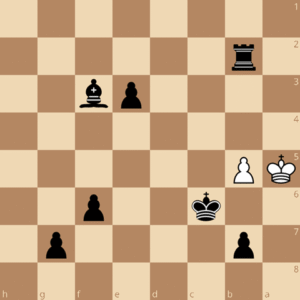
I was playing Black and faced this pawn check. I played what was probably the worst move in the position – Kc5.
I was super excited, thinking it would help my team to win the match.
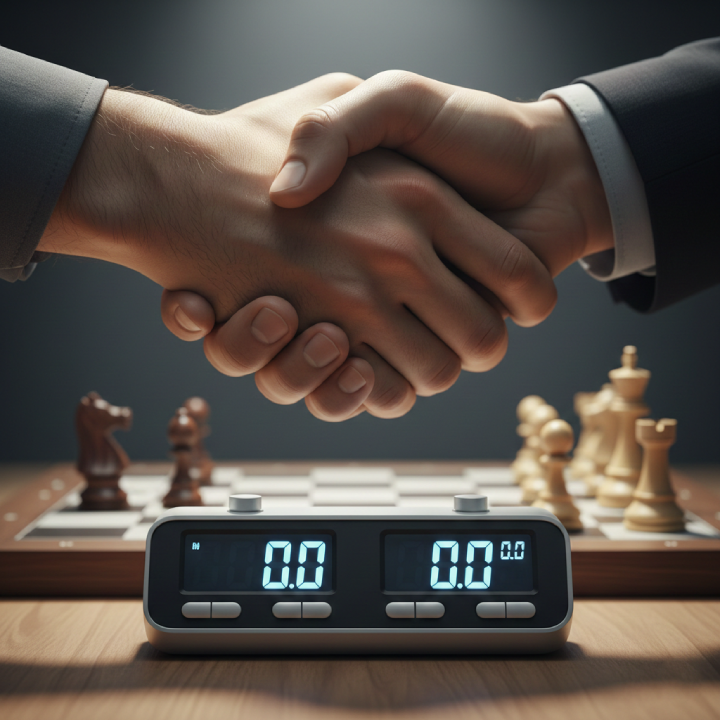
I was relaxing after the move, expecting checkmate in a few moves. At that time, my opponent shook hands with me. Naive me thought he was resigning!
When he said, “it’s a draw”, I immediately looked at the board and saw the stalemate. I was shocked and embarrassed as a crowd was watching the game. That fatal blunder cost my team the match, 1.5-2.5.
You have probably faced similar situations in online or over-the-board (OTB) chess. It’s extremely annoying, isn’t it?
You must avoid stalemates to win games – and to do that, understand what a stalemate really is in the first place.
This article covers the drawing rules and situations in chess. You may know some already, but others might be new to you.
Let’s jump into action!
The chess situations are sorted from the most common to the least.
Insufficient Material
The goal in chess is to trap the king until it has no escape, aka a checkmate. Well, you win games if opponent resigns. But we’ll focus on checkmate here.
In the endgame, we are often left with few pieces. If it is not possible to checkmate the enemy king with what’s left of the pieces, it’s a draw by insufficient material.
To deliver checkmate, you need some minimum material. It might be impossible to checkmate if you run out of pieces.
For example, opponent has only a king, and you have your king and one bishop – either one of dark-squared or light-squared. You cannot, checkmate them with this material. It’s a draw by insufficient material. You get the idea.
The game is a draw by insufficient material if your opponent has only a king and you have –
- King + One Bishop
- King + One Knight
And mostly –
- King + Two Knights
King + Two Knights not ALWAYS a draw. In rare cases, it can be a forced mate.
King vs King
This is a special mention. When both the players are left with only their kings, it’s a draw by insufficient material as well.
In chess, kings cannot be placed right next to each other. It’s an illegal move.
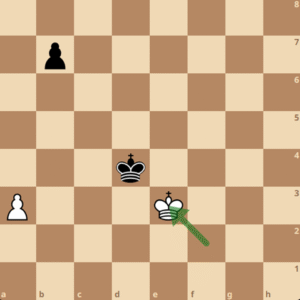
That’s a position from the game of GM Vidit vs. GM Hikaru, Tata Steel India Blitz 2019—that’s an illegal king move!
Kings must stay at least one square away from each other.
Let’s get back to our point.
If there are only two kings on the board, and they must be at least one square away from each other – and they are allowed to move – the game would never end.
You can shuffle them on the board forever – since it is not possible to checkmate with only your king.
Thus, this is a draw by insufficient material.
Stalemate
Stalemate—that annoying thing again, right? Not quite!
You already know what it is. A stalemate is when your opponent has no legal move left and their king isn’t in check.
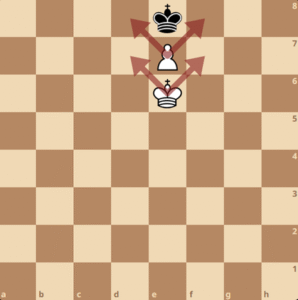
This is a classic example of stalemate. Black to move – and Black has no legal moves. Plus, the Black king is not in check.
This results in an immediate draw.
However, stalemate ideas can be handy sometimes – not if you accidentally play a move out of excitement like I did and settle for 0.5 points.
Many endgame defenses rely on stalemate tricks. Let’s revisit my story.
My opponent blundered a royal fork on the 4th move. He was in a complete loosing position the whole game.
When we both realized it was a draw by stalemate, I was in frustration while he was celebrating with his teammates like a win.
In a pawn endgame, where the attacking king right beside or behind the pawn it’s promoting – that’s a draw if played correctly.
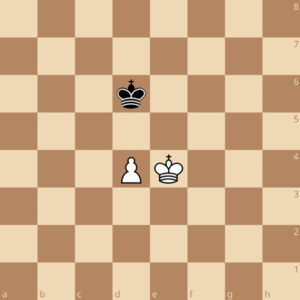
In such endgames, the defending side must put the king in front of the promoting pawn or take opposition. That is enough to avoid losing and result in a draw or a forced stalemate.
If you are defending these positions, you would be thrilled with a stalemate. So, stalemates aren’t always annoying.
Threefold Repetition
If players repeat the exact same move three times in a row, one can claim a draw by the rule of threefold repetition. Precisely, if a game reaches the same position three times in a row, that’s a threefold repetition.
The player to move, must claim the draw. Otherwise, the game will continue and not be a draw.
The claim-thing only applicable for over the board games. The game is automatically a draw in online chess if the same position occurs thrice in a row.
Professional players can spot repetition beforehand. They may then agree on a draw even before the repetition occurs.
Threefold repetition can be handy in loosing positions. You can avoid a loss by repeating moves. On the other hand, you must avoid repetition if you are winning. You don’t want to draw a winning game, do you?
Sometimes, repetition is forced – the only way to save the game.
The 50-move Rule
If 50 consecutive moves pass without any pawn move or any capture, the player to move can claim a draw.
They must claim it; this is not automatic.
There are endgames that are drawish. However, one might grind for a win in a potential draw game by constantly trying out till checkmate – or resignation. The 50-move rule prevents that.
Furthermore, the rule extends to 75 moves.
If players make 75 consecutive moves without any pawn move or any capture, the arbiter may call the game a draw by the 75-move rule.
These two rules give both the players an equal opportunity in a game.
The 50-move, and 75-move rules motivate players to study endgames and convert winning positions efficiently before opponent claims a draw.
In online chess, however, the 50-move draw is automatic. Hence, it doesn’t reach till 75 moves.
Many beginners and amateurs learn and play chess online, they might have missed the 75-move draw rule while learning. Well, now you know.
Draw by Agreement
Do you know the shortest game of Magnus Carlsen’s career? In case you don’t, it’s only 5 moves!
It happened at the 2019 Tata Steel India Rapid & Blitz tournament in Kolkata against GM Vidit Gujrathi. See the final position below– Magnus was playing the White pieces.
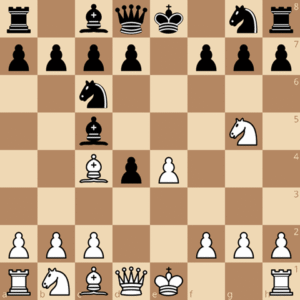
Vidit – with the Black pieces – offered a draw after 5.Ng5 – and Magnus instantly accepted it.
Magnus was not feeling well because he had an upset stomach, which is why he wanted to end the game quickly.
The key point is that you can draw a chess game through mutual agreements. If both players satisfied with a draw, they can do so at any stage of the game.
However, draw offers aren’t always accepted. You may offer your opponent a draw – but it is entirely up to them whether they accept it or not. If they believe they have a winning position, the chances are high that they will decline the offer.
One might offer draw if they see a potential threefold repetition, a possible stalemate, a drawish endgame, or have a stomach issue!
The Bottom Line
Draws are an important part of chess. A draw can feel disappointing for one player and worth celebrating for the other. Sometimes, it becomes a useful tool to avoid loss.
Understanding the different drawing conditions can be a powerful weapon in critical positions. Now you have that weapon ready for the battlefield – you know how to draw.
You may try to save a lost position with stalemate ideas, refuse to resign until you reach that 50-move mark, or repeat moves if you have an upset stomach, and so on. These are all practical drawing strategies in chess
Draw is a strategy in chess. It helps you defend difficult positions, and even save completely lost games. Most importantly, you now know when and how to claim a draw.
You can explore other articles on the website to learn more about chess.